
RFID: Current Status and Prospects of Commercial Applications
RFID (Radio Frequency Identification) serves as a core sensing-layer technology for the Internet of Things. Featuring contactless reading, bulk identification, full traceability and high durability, it functions as a unique “digital ID” for various physical goods. Gradually evolving from a single and simple identification tool, RFID has become an indispensable infrastructure supporting the digital transformation of global supply chains, intelligent manufacturing and smart urban construction. In terms of market scale, the global RFID market size reached USD 16.7 billion in 2025, while the Chinese market amounted to RMB 612 billion. As the world’s largest RFID application market, China is projected to see its market scale exceed RMB 1.8 trillion by 2030, with a compound annual growth rate (CAGR) of over 17%, demonstrating huge development potential.
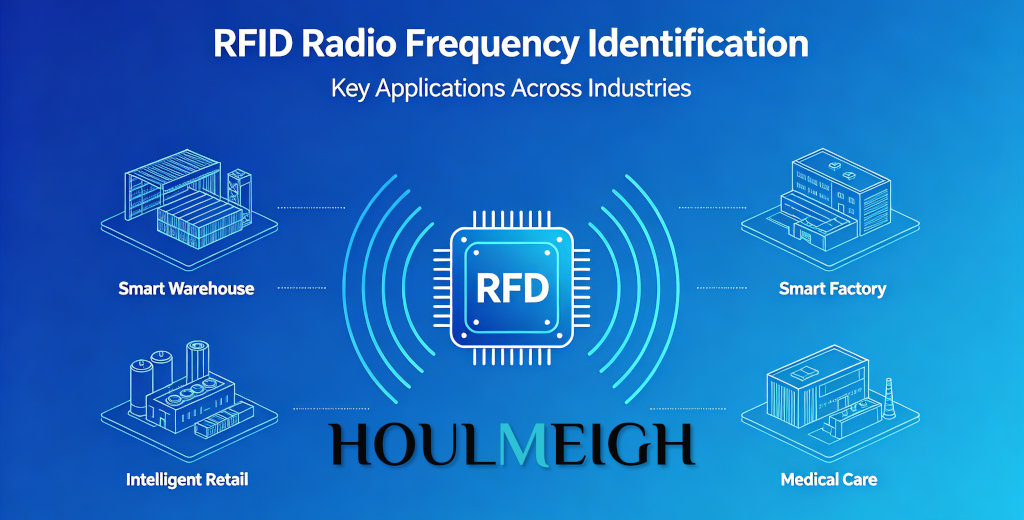
At present, RFID technology has achieved large-scale and mature commercial application in four core fields. The logistics and supply chain industry boasts the highest market penetration rate, accounting for more than 50% of the overall market share. In smart warehouse scenarios, RFID sorting efficiency is 60 times that of manual operation, with a maximum throughput of 30,000 pieces per hour and an extremely low mis-sorting rate of 0.008%. In terms of asset management, the adoption of RFID-enabled standard pallets and turnover containers reduces enterprise asset loss by 60% and improves overall turnover efficiency by 35%. For cold chain logistics, intelligent RFID tags equipped with temperature and humidity sensing functions can trigger real-time alerts for abnormal environmental conditions, cutting the loss rate of pharmaceutical logistics from 5% to 0.5% and greatly improving the safety and stability of cold chain transportation.
In the new retail industry, RFID has become a standard configuration for digital store transformation. Many mainstream retail brands including Uniqlo and ZARA have fully applied RFID technology for inventory management, achieving an inventory accuracy rate of over 95% and an 80% improvement in inventory counting efficiency. The technology also supports bulk instant checkout, realizing contactless and fast payment for customers and effectively reducing store labor and time costs. In addition, embedding RFID chips in luxury goods optimizes the anti-counterfeiting and traceability system of high-end products, significantly improving anti-counterfeiting inspection efficiency by 90% and safeguarding brand value and consumer rights.
For smart manufacturing, RFID is a core sensing tool for the implementation of Industry 4.0. It realizes flexible mixed-model production and full-process tracking of semi-finished products and components, bringing the assembly error rate of industrial production close to zero. In equipment operation and maintenance management, real-time positioning and status monitoring based on RFID technology shortens equipment failure response time by 40% and reduces the overall equipment failure rate by 15%. Integrated with the Manufacturing Execution System (MES), RFID technology further optimizes production processes and improves the overall product yield by 5% to 10%, greatly enhancing manufacturing intelligence and production efficiency.
The healthcare industry, as a high-demand and high-safety requirement scenario, also widely adopts RFID technology. More than 40% of hospitals have applied RFID for medical supplies management, reducing the quantity of expired medicines by 72% and achieving a pharmaceutical inventory accuracy rate of 99%. RFID patient wristbands and surgical instrument tags effectively eliminate medical matching errors, and improve the counting efficiency of surgical instruments by 90%. In vaccine cold chain management, the technology supports precise temperature control within ±0.5℃, shortening the response time for recalling problematic medical supplies from 72 hours to 6 hours and comprehensively upgrading medical safety supervision capabilities.
Despite its mature commercial applications, the RFID industry still faces prominent bottlenecks restricting further large-scale popularization. First of all, cost constraints remain the primary barrier. Passive RFID tags are more expensive than traditional barcodes, while active positioning tags have a high unit price, making it difficult to promote their application in low-value commodity scenarios. Secondly, environmental interference affects recognition stability. Metal and liquid materials in complex application scenarios will disrupt RFID signal transmission, resulting in fluctuating reading rates, which requires enterprises to equip customized antennas and professional supporting devices. Furthermore, there are prominent problems in data security and industry standardization. Long-distance reading characteristics bring potential data privacy leakage risks, while fragmented frequency bands and communication protocols worldwide hinder cross-platform and cross-industry data interconnection and resource sharing.
Looking ahead, the RFID industry will usher in comprehensive upgrading and rapid development driven by technological innovation, cost reduction and industrial iteration. In terms of technological development, RFID is evolving from a single identification technology to intelligent sensing by integrating with emerging technologies such as AI, blockchain and 5G. This integrated innovation enables RFID to realize real-time status monitoring, intelligent data decision-making and tamper-proof full-process traceability, empowering high-end scenarios such as unmanned warehouses, intelligent retail and refined risk control.
In terms of market expansion, the continuous decline in tag costs will drive the technology to expand from high-value products to full-category popularization. It is expected that the cost of RFID tags will drop below RMB 0.05 by 2030, which will accelerate their penetration in fast-moving consumer goods, daily chemicals, agricultural products and other low-value industries. Meanwhile, emerging application scenarios including airline baggage tracking, smart parking and urban asset management will gradually mature and become new growth points of the industry.
In terms of industrial chain development, domestic chip technological breakthroughs have effectively reduced hardware costs, breaking the long-term overseas technological monopoly. The industry business model is also undergoing transformation, shifting from simple hardware sales to integrated service solutions covering SaaS subscription and data operation, which greatly improves the overall profit margin of the industry.
To conclude, RFID technology has achieved technical maturity and verified commercial value in mainstream industries, and the entire industry is currently at a critical inflection point of large-scale popularization. In the short term, continuous cost reduction and unified industry standards will further accelerate cross-industry penetration and application. In the long run, as a fundamental supporting technology for the Internet of Everything, RFID will reshape the operation efficiency and trust mechanism of supply chains, retail, manufacturing and urban governance, with a stable and huge market potential, showing broad and promising development prospects.